The Fan Theory That Will Not Die - And What Actually Happened
You have definitely heard the theory. Raikou, Entei, and Suicune were originally three Eevee evolutions - Jolteon, Flareon, and Vaporeon - who died in the fire that burned down the Brass Tower in Ecruteak City. Ho-Oh found them, resurrected them, and transformed them into something new and legendary.
It is a great theory. The types line up perfectly. The designs have enough visual DNA to make it feel deliberate. The emotional weight of it - three ordinary Pokémon transformed into legendaries through death and divine intervention - is exactly the kind of lore Game Freak would encode quietly into the world and never explain. It feels true.
Okay but here is the thing: it was never confirmed. Not in the games, not in any Pokédex entry, not in the anime, not in official supplementary material. The three Pokémon who died in the Brass Tower fire are identified in the lore as "three unnamed Pokémon." Full stop. The Eevee connection is fan inference, not canon.
What is confirmed is wild enough on its own - and the Japanese names of the three beasts are basically a compressed lore document anyone can read.
Key Takeaways
- Three unnamed Pokémon died when the Brass Tower in Ecruteak City burned down 150 years before the events of Gold and Silver
- Ho-Oh resurrected them with the power of the three forces that destroyed the tower: lightning (Raikou), fire (Entei), and rain (Suicune)
- Raikou (ライコウ) = 雷 thunder + 光 light - named for the bolt that started everything, and designed after the Raijū, Japan's mythological thunder beast
- Entei (エンテイ) = 炎 flame + 帝 emperor - the Flame Emperor, designed after the guardian lion-dogs at Shinto shrines
- Suicune (スイクン) = 水 water + 君 lord - the Water Lord, designed after the kirin, the East Asian mythological chimera of purity
- The Entei in Pokémon Movie 3 is NOT the real Entei - it is a construct made by the Unown from Molly Hale's wishes
- Raikou gets its own OVA ("The Legend of Thunder!"); Suicune is the mascot of Pokémon Crystal; Entei is the star of Movie 3
What Actually Happened at the Brass Tower
Ecruteak City is built around two towers: the Bell Tower, home to Ho-Oh, and the Brass Tower - now known simply as the Burned Tower, because 150 years before you first walk into Ecruteak as a player, lightning struck it.
The fire spread. Three Pokémon living inside the tower could not escape. They died.
Ho-Oh was there. The legendary rainbow Pokémon watched from the sky as three lives ended in a tower it considered sacred ground - and it was moved enough to act. Ho-Oh used its power to resurrect the three dead Pokémon. But it did not simply return them to what they were. It gave each one the power of a different element that had been part of the tower's destruction.
The lightning that struck and started the fire became Raikou.
The fire that raged through the tower became Entei.
The rain that eventually fell and quenched the flames became Suicune.
Three forces. Three resurrections. Three legendary beasts - and each one carries a name that encodes exactly what it was given.
The six kanji that name these beasts appear throughout anime and lyrics. 雷 (rai) means thunder or lightning — the same character in Raijin, Japan's thunder god. 炎 (en) means flame or blaze — hotter and more literary than everyday 火 (hi). 水 (sui) means water. 光 (kou) means light. 帝 (tei) means emperor. 君 (kun) means lord or master.
Their Japanese Names Are a Lore Document
Once you know the origin story, the Japanese names land completely differently. Game Freak did not just give the three beasts cool-sounding names - they embedded the resurrection lore into the kanji themselves.
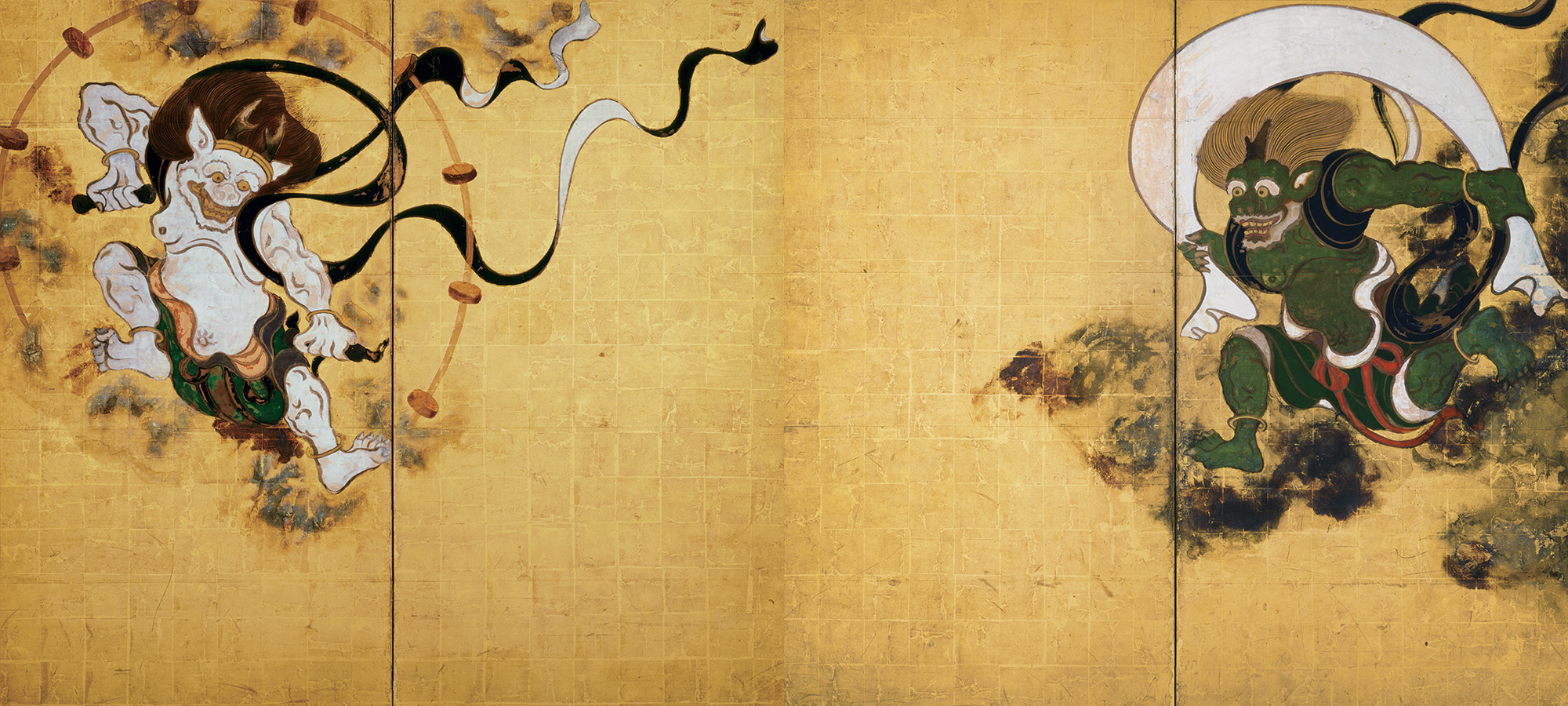
Raikou (ライコウ) is built from 雷 (rai) meaning thunder or lightning, and 光 (kou) meaning light. Thunder Light. The lightning bolt that struck the Brass Tower and started everything - that is Raikou's entire identity compressed into two characters. But 雷 also leads directly to Raijin (雷神), the Japanese god of thunder, whose mythological companion is the Raijū (雷獣) - literally "thunder beast" - a creature that rides lightning bolts and can take the form of a tiger, wolf, or cat wrapped in electrical energy.
Entei (エンテイ) is 炎 (en) meaning flame or blaze, plus 帝 (tei) meaning emperor. Flame Emperor. The fire that consumed the Brass Tower is now an emperor - massive, sovereign, absolute. 帝 is a high-register word, the same character in 天帝 (tentei, "heavenly emperor"). Entei is not just fire given form. It is imperial fire.
Suicune (スイクン) is 水 (sui) meaning water, plus 君 (kun) meaning lord or master. Water Lord. The rain that saved the world from Entei's fire - now made noble. 君 carries connotations of gentleness and benevolence alongside its authority: it is also the honorific used between equals or for a trusted young lord. Suicune's graceful, purifying design reflects exactly this register.
| Kanji | Romaji | Meaning |
|---|---|---|
| 雷 | rai | thunder, lightning |
| 光 | kou | light |
| 炎 | en | flame, blaze |
| 帝 | tei | emperor |
| 水 | sui | water |
| 君 | kun | lord, master |
| 雷神 | Raijin | god of thunder |
| 雷獣 | Raijū | thunder beast |
| 伝説の獣 | densetsu no kemono | legendary beasts |
These kanji compound throughout Japanese vocabulary. 雷雨 (raiu) means thunderstorm — 雨 means rain. 炎上 (enjou) means internet firestorm or burning up. 水泳 (suiei) means swimming. 光年 (kounen) means light-year. 帝国 (teikoku) means empire — 国 means country. 君主 (kunshu) means monarch or sovereign.
The Real Creatures Behind Each Design
The types and names come from the Brass Tower lore - but the visual designs pull from three specific creatures in Japanese and East Asian mythology. This is where the Eevee theory falls apart: each legendary beast has its own mythological source that goes far beyond a type match.
Raikou - The Raijū (雷獣)
Raikou is a portrait of the Raijū, the mythological thunder beast of Japanese folklore. The Raijū travels inside lightning bolts and can appear as a tiger, wolf, cat, or weasel wrapped in fire or electricity. When it lands, it scorches trees from the inside - which is why split trees after lightning strikes were said to show the Raijū's claw marks passing through.
Look at Raikou: the saber-toothed profile, yellow-and-black striped body, a wild mane of storm clouds. That is the Raijū visualized as a Pokémon, with the colors of Raijin's thunder drums worked into the design. The Raijū is not some obscure reference - it appears throughout Japanese art, and its association with Raijin makes it one of the most recognizable mythological animals in the culture.
Suicune - The Kirin (麒麟)
Suicune's design is more layered. The most direct source is the kirin (麒麟), known in Chinese as the qilin - a mythological chimera associated with purity, good omens, and the arrival of a great ruler. The kirin has hooves, scales, and a flowing mane, and is said to walk so lightly it does not bend a single blade of grass or harm a single living thing.

Suicune's aurora-like tail, graceful proportions, and its ability to purify contaminated water (shown directly in Movie 4) map to kirin symbolism precisely. The kirin appears when the world is at peace or when something sacred is about to arrive. Suicune moves through the world the same way: it arrives at lakes and rivers, purifies them, and continues north. No territory. No aggression. Just its presence improving whatever it touches.
Several Pokédex entries associate Suicune with the north wind, which connects back to its Brass Tower origin - the rain arriving from the north, cooling and cleansing the fire that Entei represents.
Entei - The Komainu (狛犬)
Entei's design pulls from the komainu (狛犬), the guardian lion-dogs that stand at the entrance to Shinto shrines across Japan. Also called shisa in Okinawa, these stone guardians have a massive muscular build, a wild cloud-like mane, and an expression of absolute power and resolve. At most shrines, one has its mouth open (saying "ah") and one has it closed (saying "un") - together they represent the first and last sounds of existence.

Entei's silhouette is unmistakably komainu: the giant head, the smoke-cloud mane, the thick powerful legs, the presence of something that exists to guard something sacred. Combined with 帝 (emperor) in its name, Entei is a deified guardian beast - the fire of the Brass Tower made protector.
Anime Appearances
All three roam Johto in the anime, briefly crossing Ash's path and immediately fleeing. That mechanic - encounter and vanish - mirrors the Gold and Silver gameplay so faithfully it could feel like lazy writing, but it works as characterization. These are not Pokémon waiting to be caught. They are something else entirely.
Entei - Pokémon Movie 3: Spell of the Unown (2000)
Movie 3 is Entei's biggest moment, but with a twist built into the premise: the Entei in this film is not the real one.
Professor Spencer Hale disappears into a world of Unown after studying their ruins. His daughter Molly is left alone. The Unown, responding to her grief, begin making her wishes real. Molly wishes for a father figure - specifically the Entei from her childhood memories of her father's research. The Unown manifest an Entei from those memories, and this constructed Entei becomes the film's emotional center.
This Entei is genuinely tender and genuinely dangerous. It kidnaps Delia Ketchum to be Molly's "mama" because Molly wants a complete family. It fights Ash's Charizard in a serious and memorable battle. It protects Molly with absolute devotion - not because it is the real legendary beast, but because for Molly, it is her father, and it believes that completely. At the end of the film, when the Unown's world begins collapsing, this constructed Entei chooses to act - using its power to free Molly even at cost to itself.
The film never pretends this is the real Entei. What makes it extraordinary is that it does not need to be. A dream Entei who genuinely loves the child it was built to protect is its own kind of legend.
Raikou - The Legend of Thunder! OVA (2001)
Raikou is the only one of the three that got a full story arc built around it - and crucially, one that does not involve Ash at all.
"The Legend of Thunder!" is a Pokémon Chronicles special featuring Jimmy (Kenta in Japanese) and Marina as protagonists. Team Rocket agents Attila and Hun deploy an energy-draining system targeting Raikou specifically, trying to capture it for Giovanni. Jimmy and Marina race to stop them while Raikou fights back alone, cornered and weakening.
The OVA gives Raikou genuine combat agency. It does not flee. It stands and fights, even outmatched. If you have only ever seen Raikou get scared off by Ash in two seconds and disappear for forty episodes, this special functions as a corrective - it shows what the thunder beast actually is when it is not just a roaming mechanic.
Suicune - Pokémon Crystal and Movie 4
Suicune's most significant appearance is not a film or OVA. It is being chosen as the mascot of Pokémon Crystal (2001).
Crystal redesigned the Suicune encounter to be a fixed story event rather than a random roaming encounter. The game added Eusine - called Minaki in Japanese - a researcher who has spent years tracking Suicune across Johto and functions as the game's rival energy for that particular hunt. He admires Suicune with the kind of focused, slightly obsessive devotion that makes him feel real. Eusine also appeared in the anime, giving Suicune the closest thing to a recurring human relationship that any of the three beasts has.
In Movie 4: Celebi: Voice of the Forest (2001), Suicune gets a smaller but visually striking role: it appears at a forest lake corrupted by the Iron-Masked Marauder and purifies it, its aurora tail trailing across the water. No dialogue, no major fight. Just the act of purification, which is exactly what the kirin does. One of the quieter and more beautiful moments in any Johto-era film.
Why This Matters for Your Japanese
The kanji in Raikou, Entei, and Suicune are not decoration. They are a habit of Japanese game and anime design that runs extremely deep: name a creature after what it fundamentally is, using the most precise and potent character available.
雷 (rai) for thunder appears constantly - in Raijin, in 雷雨 (raiu, thunderstorm), in the original Japanese name for Pikachu's species (雷 being one reading for kaminari, thunder). 炎 (en) for flame is the intense literary version of fire, hotter and more formal than the everyday 火 (hi). 水 (sui) is water in its Sino-Japanese reading, the reading that shows up in compound words like 水泳 (suiei, swimming), 水分 (suibun, moisture), and 水面 (suimen, water surface).
Once you can read these characters, the Pokédex becomes a vocabulary drill wrapped in lore. And that same pattern runs through every major franchise.
The Naruto universe does the exact same thing - every Uchiha Mangekyou technique is named after a real Shinto deity pulled from Japan's oldest religious texts. Read: Why Are Uchiha Jutsus Named After Japanese Gods?
And if the Pokémon mythology pipeline interests you, Magikarp and Gyarados encode a 6th-century Chinese legend about koi climbing a waterfall to become dragons - the exact same developer instinct, a different myth.
Explore the song library on KitsuBeat - 雷, 炎, and 水 all appear constantly in anime openings, and recognizing them in lyrics hits differently once you know the thunder beast, the flame emperor, and the water lord behind each character. Or browse the full Journal for more deep dives into the mythology encoded in the franchises you already know.
FAQ
What are Raikou, Entei, and Suicune?
Raikou, Entei, and Suicune are the three legendary beasts of Johto, introduced in Pokémon Gold and Silver (1999). They are Electric, Fire, and Water type respectively, and roam the Johto region as wild Pokémon that flee immediately when encountered - making them some of the most frustrating and memorable catches in the series. Their official designation is "legendary beasts" (伝説の獣, densetsu no kemono).
What is the actual lore behind them?
150 years before the events of Gold and Silver, the Brass Tower in Ecruteak City was struck by lightning and burned down. Three unnamed Pokémon died inside. Ho-Oh, witnessing their deaths, resurrected them and gave each one the power of a different force that destroyed the tower. The lightning that struck became Raikou. The fire that consumed the tower became Entei. The rain that quenched the flames became Suicune.
Were they Eevee evolutions before Ho-Oh resurrected them?
No. This is one of the most persistent fan theories in Pokémon - it points to the matching types (Jolteon/Electric, Flareon/Fire, Vaporeon/Water) and visual design echoes. But it has never been confirmed in any game, anime, or official Pokémon material. The three Pokémon who died in the Brass Tower fire are simply called "three unnamed Pokémon" in every official source.
What do their Japanese names mean?
Raikou (ライコウ) = 雷 (thunder) + 光 (light) = Thunder Light, named for the bolt that started everything. Entei (エンテイ) = 炎 (flame) + 帝 (emperor) = Flame Emperor, the fire of the tower made sovereign. Suicune (スイクン) = 水 (water) + 君 (lord) = Water Lord, the rain that ended the disaster made noble.
What mythological creatures are they based on?
Raikou draws from the Raijū (雷獣), the Japanese mythological thunder beast that rides lightning and appears as a tiger or wolf wrapped in electricity - companion to the thunder god Raijin. Entei draws from the komainu (狛犬), the guardian lion-dogs at Shinto shrines. Suicune draws from the kirin (麒麟), the East Asian mythological chimera associated with purity, good omens, and the north wind.
Is the Entei in Pokémon Movie 3 the real one?
No. The Entei in "Spell of the Unown" is a construct created by the Unown from Molly Hale's wishes and her memories of her missing father. The film makes this explicit - it is not the legendary Entei that roams Johto. What makes Movie 3 remarkable is that the constructed Entei develops genuine emotional stakes despite not being real, and its final choice in the film lands hard precisely because of that.
Why does Suicune appear specifically in Pokémon Crystal?
Pokémon Crystal (2001) redesigned the Suicune encounter from a roaming random encounter into a fixed story event tied to the game's new character Eusine, a researcher obsessed with tracking Suicune. Game Freak chose Suicune as Crystal's mascot and gave it more story presence than Raikou or Entei received in the original Gold and Silver, making it the most developed of the three in the main series before any anime adaptation.
Are they dogs, cats, or beasts?
The official designation is "legendary beasts" (伝説の獣, densetsu no kemono). Early English marketing called them "legendary dogs." Then "legendary cats" became popular in fan communities after people noticed feline features. Nintendo eventually settled on "legendary beasts" officially, which is also the most accurate - each one is based on a mythological chimera with no direct animal equivalent.