You've Been Saying These Words for Years. Here's What They Mean.
Millions of people spent years yelling "RASENGAN" and "CHIDORI" and "KAGE BUNSHIN NO JUTSU" without knowing what any of those words mean. That's not a problem - that's just how anime absorption works. The phonetics come first. The meaning catches up later.
Here's what nobody told you: every single technique name in Naruto is a literal description in Japanese. Masashi Kishimoto didn't invent random sounds. He named each jutsu exactly what it does, using kanji that anyone studying Japanese can read directly. The Rasengan is a "Spiraling Sphere." Chidori is "One Thousand Birds." The Rinnegan is the "Samsara Eye" - from the Buddhist concept of the cycle of rebirth. Once you know what these words are made of, every fight scene lands differently.
Okay but here's the actual payoff: learning these translations is a backdoor into the Japanese writing system. You already know how to say the words. You just need to know what the kanji inside them mean.
Key Takeaways
- 術 (jutsu) means technique or art - every Naruto jutsu name is literally "[concept] + technique"
- Rasengan (螺旋丸) means Spiraling Sphere - each of the three kanji describes the physical technique exactly
- Chidori (千鳥) means One Thousand Birds - named after the sound of electricity crackling through the arm
- Raikiri (雷切) means Lightning Cutter - because Kakashi literally cut a bolt of lightning, and there is a real Japanese sword with this name
- Sharingan (写輪眼) means Copy Wheel Eye - the character 写 is the same one used in the Japanese word for photograph
- Rinnegan (輪廻眼) means Samsara Eye - from the Buddhist cycle of death and reincarnation, the concept that defines Nagato's power
- The Edo in Edo Tensei is NOT the historical city that became Tokyo - it means "defiled earth," a Buddhist term for the world of suffering
Kakashi using the Chidori for the first time. Listen for the crackling sound that gave it the name 'one thousand birds':
術 - What "Jutsu" Actually Means
Before the individual techniques, let's deal with the word everyone uses without thinking.
術 (jutsu) means technique, art, or method. It appears in real Japanese constantly: 武術 (bujutsu, warrior art), 医術 (ijutsu, medical art), 手術 (shujutsu, surgery - literally "hand technique"). When Naruto characters say "jutsu," they're saying something closer to "art form" than "magic trick."
The three categories of jutsu break down cleanly:
Ninjutsu (忍術, ninjutsu) - The key kanji is 忍 (nin/shinobi). Break it down: a blade (刃, ha) sitting above a heart (心, kokoro). The character itself means to endure, to persevere through pain. Ninjutsu is literally "the art of endurance." Not just ninja technique - it's a philosophy about suppressing yourself and your emotions to survive and accomplish the mission. Itachi embodies this more than anyone in the series.
Genjutsu (幻術, genjutsu) - 幻 (gen) means illusion, phantom, or hallucination. The same character appears in 幻想 (gensou, fantasy/illusion) and 幻覚 (genkaku, hallucination). The art of illusions.
Taijutsu (体術, taijutsu) - 体 (tai) means body. Physical technique. This is a real word in Japanese martial arts contexts too - it's not invented for the show. Rock Lee and Guy-sensei are, in the most literal sense, artists of the body.
And then there's Senjutsu (仙術, senjutsu) - the sage art. 仙 (sen) means sage, immortal, or supernatural hermit. The character depicts a person standing on a mountain - someone who has retreated from ordinary human life and cultivated extraordinary power through stillness and communion with nature. That is exactly what Naruto does training with the toads at Mount Myoboku. The sage art is, word for word, the art of the mountain hermit.
Rasengan and Rasen Shuriken - The Spiral Speaks for Itself
Rasengan (螺旋丸, rasengan). Three kanji. Three descriptions of the same compressed sphere of rotating chakra.
螺 (ra) - a spiral shell, a conch shell. The shape of the spiral as it exists in nature - the nautilus, the snail, the cochlea of the ear.
旋 (sen) - to rotate, to revolve, to spin. The same character used in 旋回 (senkai, revolution/rotation) and 旋風 (senpuu, whirlwind).
丸 (maru) - round, sphere, ball. Also used as a suffix for Japanese ship names and sword names - something complete and whole in itself.
Put together: the Rotating Shell Sphere. A sphere of chakra compressed into a spinning spiral pattern. That is exactly what the Rasengan is, mechanically. Minato Namikaze looked at the technique he spent three years developing - a contained sphere of self-rotating chakra requiring no hand seals, held together by will alone - and wrote the description in three kanji. The name is a technical specification.
Rasen Shuriken (螺旋手裏剣, rasen shuriken) stacks another layer on top. 手裏剣 (shuriken) breaks down as 手 (te, hand) + 裏 (ura, hidden/behind) + 剣 (ken, sword). A sword hidden inside the hand. When Naruto adds the Rasengan's spiral structure to the shuriken's cutting geometry, the combined name is: spiral + sword-hidden-in-the-hand. Both words are architectural descriptions. The technique name is a blueprint.
Chidori and Raikiri - Where the Birds Come In
This is the translation that confuses people most, and it's the most satisfying once you get it.
Chidori (千鳥, chidori) means One Thousand Birds. The crackling electrical current flowing through the arm sounds - to Japanese ears - like a flock of a thousand birds crying out at once. Kakashi Hatake named it that because that is what it sounded like when he first used it.
千 (chi) - thousand. The same character in 千歳 (chitose, a thousand years, used in congratulatory phrases) and 千手 (Senju, a thousand hands - as in Hashirama Senju).
鳥 (tori) - bird. One of the most essential kanji for the animal. 小鳥 (kotori, small bird), 渡り鳥 (wataridori, migratory bird), 鳥居 (torii, the Shinto gate - literally "bird dwelling").
One Thousand Birds is not a metaphor about power. It's onomatopoeia turned into a name. The sound the electricity makes became the technique's identity.
Then Kakashi was told he couldn't become Hokage and cut a literal bolt of lightning with the technique. That is when it became Raikiri (雷切, raikiri).
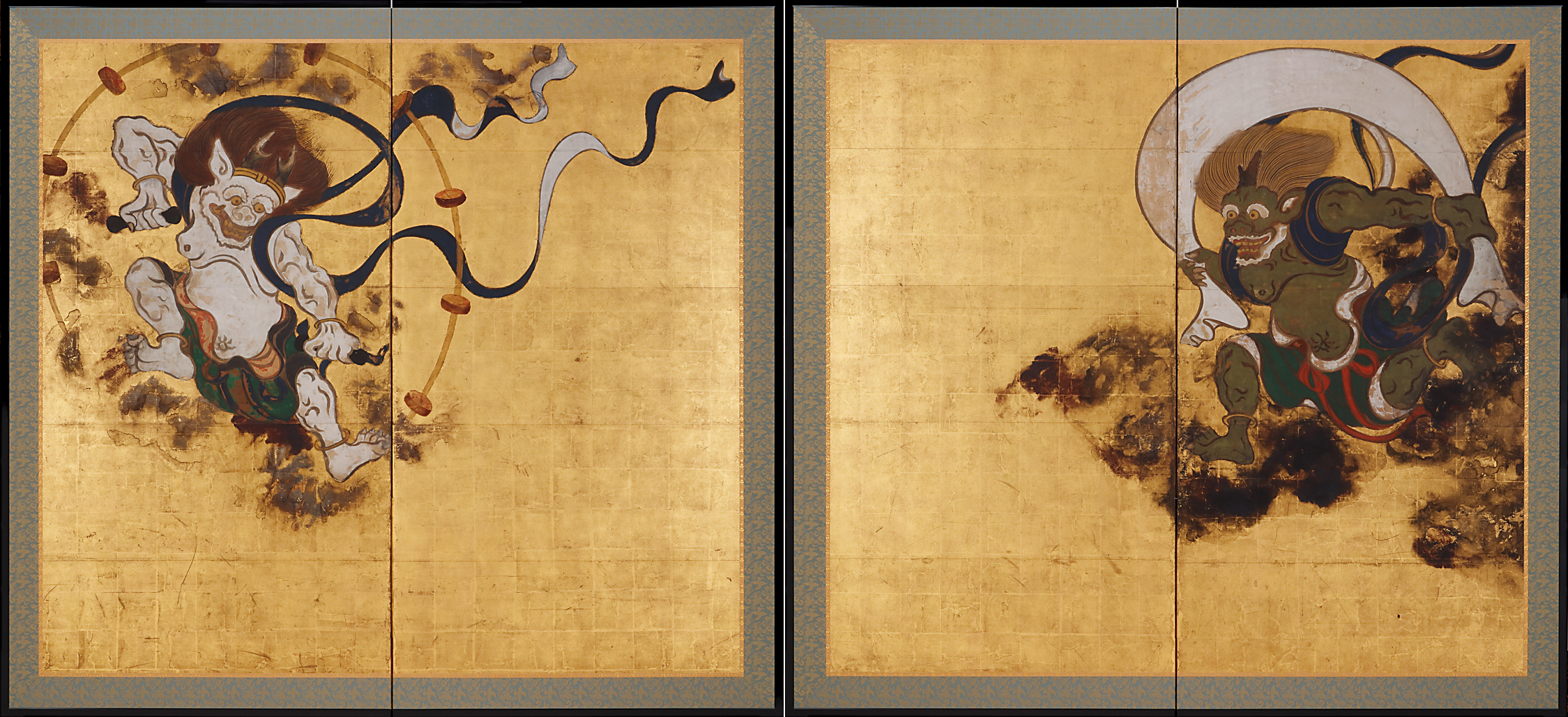
雷 (rai) - thunder, lightning. The same kanji in 雷神 (Raijin, the thunder god) - whose 13th-century wooden sculpture from Sanjusangendo temple in Kyoto is shown below. The character 雷 shows rain (雨) over fields (田) - lightning driving down from a storm sky to the earth beneath it.
切 (kiri) - to cut. 切る (kiru). One of the most common verbs in Japanese, used for everything from cutting hair to cutting ties.
Lightning Cutter. A technique named after a feat its user actually performed. It is also, quietly, the name of a real Japanese blade from the Edo period - a sword held to be supernaturally sharp, said to have once cut lightning. Kishimoto knew.
(Both names refer to the same technique. Chidori is the original. Raikiri is what it earned.)

Kage Bunshin - The Shadow That Divides Itself
Kage Bunshin no Jutsu (影分身の術, kage bunshin no jutsu) - the technique Naruto uses more than almost anything else in the series. Word by word:
影 (kage) - shadow. The same character used in 影武者 (kagemusha, shadow warrior or body double) and 陰謀 (inbou, conspiracy - literally "scheming in shadows"). Something that exists in correspondence with a real thing but is not itself the source.
分身 (bunshin) - divided self. 分 (bun) means to divide, split, or separate - it appears in 分かる (wakaru, to understand, literally "to divide and know") and 部分 (bubun, a portion or part). 身 (mi) means body or self - it's in 自身 (jishin, oneself) and 身体 (shintai, the body). A bunshin is not a copy in the science-fiction sense. It is a divided self - a portion of you that has been separated out and made to exist independently.
の (no) - the possessive particle. The shadow's divided self. The の tells you the structure: the shadow modifier belongs to what the bunshin is.
術 (jutsu) - technique.
The "shadow" part distinguishes this from standard Bunshin no Jutsu (分身の術) - the basic clone that creates insubstantial images with no physical presence. Kage Bunshin are real. They can fight, carry objects, experience things, and when they dispel, the original receives everything they learned. That mechanic is exactly what "divided self" means: each clone carries a genuine portion of Naruto's identity while it exists, and returns it on dispel. The forbidden rating comes from this - splitting yourself into hundreds of complete selves carries real physiological cost. The shadow qualifier is the flag that tells you: this one counts.
The Three Eyes - One Kanji Per Vision
The three major dojutsu (瞳術, dojutsu, pupil/eye technique) each describe precisely what makes that eye different.
Sharingan (写輪眼)
写 (sha) - to copy, to transcribe, to photograph. The same character in 写真 (shashin, photograph - literally "copying truth"). 写す (utsusu) means to copy or reflect. This is not a vague association - the 写 in Sharingan and the 写 in the word for photography are the same character doing the same conceptual work.
輪 (rin) - wheel, ring, circle. Appears in 輪っか (wacca, ring/loop), 日輪 (nichirin, the sun's wheel/disc), and 法輪 (hourin, the dharma wheel, a Buddhist symbol). The spinning tomoe marks rotating around the pupil are the wheel.
眼 (gan) - eye. The formal, literary character for eye versus 目 (me), the everyday one. 目 is what you say when you bump your eye. 眼 is what you use in technique names, poetry, and medical terms. The Sharingan uses the literary eye character because it is, above all things, a literary technique - one that reads, copies, and transcribes.
Copy Wheel Eye. The name describes the design (a spinning wheel in the pupil) and the function (it copies what it sees) simultaneously. Kishimoto fit everything important about the Sharingan into three kanji.
Byakugan (白眼)
白 (byaku/shiro) - white. Pure white. The same character in 白雪 (shirayuki, white snow), 白虎 (byakko, the White Tiger of the four divine beasts), and 白紙 (hakushi, blank paper - starting from white). In Japanese cultural contexts, white often carries connotations of purity, emptiness, and an unobstructed state.
眼 (gan) - eye.
White Eye. The near-pupil-less, almost entirely white iris of the Hyuga clan, which sees in 359 degrees and perceives chakra points directly. The name is visual before it is anything else - it describes what the eye looks like. But the "white" connotations of purity and emptiness fit an eye that sees through almost every obstruction, that is most powerful precisely when it is most uncluttered.
Rinnegan (輪廻眼)
This is the deepest name of the three.
輪廻 (rinne) is the Japanese term for samsara - the Buddhist concept of the endless cycle of birth, death, and rebirth. 輪 (rin) = wheel, 廻 (ne/mawa) = revolving. Literally: the revolving wheel of existence. This is the philosophical framework of karma - the idea that consciousness cycles through lives, that death is not an end but a transition, that the wheel keeps turning.
眼 (gan) - eye.
The Samsara Eye. The Rinnegan belongs to whoever has approached the level of the Sage of Six Paths - the person who stood at the origin of ninjutsu and closest to the concept of life-and-death as a cycle. Nagato's abilities under Rinnegan are almost entirely about crossing the boundary between living and dead: the Outer Path, the Animal Path summons from beyond death, the reviving of the dead with Rinne Tensei. The technique name 輪廻天生 (Rinne Tensei, the ultimate Rinnegan technique) uses the same rinne kanji - it is literally "Samsara Reincarnation," the wheel of existence rotating once for everyone who died.
The name carries all of that before you've even seen Pain fight.
The Forbidden Techniques - Edo Tensei and Kuchiyose
Two techniques whose names deserve a full breakdown.
Edo Tensei (穢土転生, Edo Tensei) - Impure World Reincarnation. Orochimaru's technique. Kabuto's technique. The one that brought back every dead character you didn't expect to see again.
The most important thing: the "Edo" in Edo Tensei is not the historical city of Edo (江戸) that became Tokyo. The kanji are completely different.
穢土 (edo) - defiled earth, impure land. 穢 (e) means polluted, defiled, ritually unclean. 土 (do/tsuchi) means earth, soil, ground. This is a Buddhist concept: the impure land (穢土) as opposed to the Pure Land (浄土, jodo) - the realm of Buddha's paradise where souls go after achieving the correct state. The impure land is the world of suffering and attachment we currently inhabit. Edo Tensei forces souls from the impure land back into the impure world - it is the theological inverse of the Pure Land. You are pulling souls out of whatever afterlife they reached and binding them into ash-and-living-cell bodies to fight for you.
転生 (tensei) - transmigration, reincarnation. 転 (ten) = to turn, to transfer. 生 (sei/shou) = life, birth. The same word appears in 輪廻転生 (rinne tensei) - the full Buddhist phrase for the samsara cycle connecting to the Rinnegan. Edo Tensei is specifically "forced reincarnation into the defiled earth" - using the mechanics of the natural soul cycle for violation.
Historical Edo (江戸, Tokyo's old name) means "bay door" or "inlet." The kanji share a pronunciation and nothing else.
Kuchiyose no Jutsu (口寄せの術, kuchiyose no jutsu) - the Summoning Jutsu that brings forth Gamabunta, Katsuyu, and Manda.
口 (kuchi) - mouth.
寄せ (yose) - to gather, to call toward, to summon. 呼び寄せる (yobiyoseru) means to call together. The image is of something being drawn toward you from a distance by your call.
の (no) - possessive particle.
術 (jutsu) - technique.
Mouth-Calling Technique. You bite your thumb. You press the blood seal to the contract. You call with your body. The "mouth" qualifier is not flavor detail - in Shinto and Buddhist practice, the spoken word carries sacred power (言霊, kotodama, spirit of words). The summoning contract is a spoken oath sealed in blood, and the technique name holds onto that. The mouth is the origin of the call.
Vocabulary Callout
| Kanji | Romaji | Meaning |
|---|---|---|
| 術 | jutsu | technique, art, method |
| 忍 | nin / shinobi | endure, conceal, persevere |
| 幻 | gen | illusion, phantom |
| 体 | tai | body |
| 仙 | sen | sage, immortal hermit |
| 螺旋 | rasen | spiral, helix |
| 丸 | maru | sphere, round, complete |
| 千 | chi | thousand |
| 鳥 | tori | bird |
| 雷 | rai / kaminari | thunder, lightning |
| 切 | kiri | cut |
| 影 | kage | shadow |
| 分身 | bunshin | divided self |
| 写 | sha | copy, imitate, photograph |
| 輪 | rin | wheel, ring, circle |
| 眼 | gan | eye (formal/literary) |
| 白 | byaku / shiro | white |
| 輪廻 | rinne | samsara, cycle of rebirth |
| 穢土 | edo | defiled earth, impure land |
| 転生 | tensei | reincarnation, transmigration |
The distinction between 眼 (gan) and 目 (me) is worth locking in. Both mean eye, but 眼 is the formal, literary character - you'll find it in technique names, poetry, and medical contexts. 目 is everyday. Sharingan (写輪眼) and Byakugan (白眼) and Rinnegan (輪廻眼) all use 眼 - the written, literary eye, not the casual body-part word. That choice is intentional: these are not ordinary eyes. The kanji signals that before you've even translated anything else.
Why This Matters for Your Japanese
Kishimoto named his techniques the way a poet names things - by picking the exact kanji that carry the weight of the concept. A Rasengan is a螺旋丸 not because it sounded cool, but because those three characters describe its geometry precisely. A Chidori is a 千鳥 not because birds are dramatic, but because that's what it sounded like.
This is how Japanese writing works across the board. Kanji are compressed images - a single character can carry decades of connotation, visual memory, and cultural reference. Once you know that 忍 shows a blade over a heart and means to endure, you understand ninjutsu differently. Once you know 輪廻 is the Buddhist samsara cycle, the Rinnegan stops being "god-tier eye" and becomes "the eye that sees the wheel of existence turning." The technique name is a philosophical position.
The same kanji-as-meaning system runs through every piece of anime you've ever watched - not just Naruto. Creators choose these characters deliberately, assuming a Japanese audience will catch the references. Learning to read that layer is one of the most rewarding parts of studying Japanese through anime you already love.
If you want to see how deep this goes in Naruto specifically, the Uchiha Mangekyou jutsu names - Amaterasu, Tsukuyomi, Susanoo, Izanagi, Izanami, Kagutsuchi - are a completely separate system drawn from Japan's oldest religious text. Read: Why Are Uchiha Jutsus Named After Japanese Gods?
Explore the song library on KitsuBeat - anime openings and endings are packed with the same kanji you just learned. 影 (kage, shadow), 転生 (tensei, reincarnation), 千 (chi, thousand) - they show up constantly, and now they'll land with the full weight of what they mean. Or browse the full Journal for more deep dives into the language and mythology hiding inside the anime you know.
FAQ
What does Rasengan mean in Japanese?
Rasengan (螺旋丸) means Spiraling Sphere. 螺旋 (rasen) means spiral or helix - the character 螺 depicts a spiral shell, and 旋 means to rotate. 丸 (maru) means sphere or round object. Every character in the name describes the physical technique: a sphere of chakra compressed into a spinning spiral pattern held in rotation. Minato Namikaze spent three years developing it and named it exactly what it is.
Why is Chidori called One Thousand Birds?
Chidori (千鳥) means One Thousand Birds. Kakashi named the technique after the crackling sound the electrical current makes as it flows through the arm, which sounded to him like a flock of a thousand birds crying out at once. 千 (chi) means thousand and 鳥 (tori) means bird. The name is onomatopoeic - not a description of what the technique looks like, but what it sounds like when activated.
What does Sharingan mean in Japanese?
Sharingan (写輪眼) means Copy Wheel Eye. 写 (sha) is the character for copy or imitate - the same one used in 写真 (shashin, photograph, literally "copying truth"). 輪 (rin) means wheel or ring, referring to the spinning tomoe pattern. 眼 (gan) is the formal literary character for eye. The name describes both what the eye does (copies techniques) and what it looks like (a spinning wheel pattern in the iris).
Is the Edo in Edo Tensei the same as Tokyo's old name Edo?
No. The Edo in Edo Tensei (穢土転生) uses completely different kanji from the historical city of Edo (江戸). Edo Tensei uses 穢土, meaning defiled earth or impure land - a Buddhist concept for the world of suffering as opposed to the Pure Land of paradise. Historical Edo (Tokyo) uses 江戸, meaning bay door or inlet. Same pronunciation, completely different meaning and characters.
What does Rinnegan mean in Japanese?
Rinnegan (輪廻眼) means Samsara Eye. 輪廻 (rinne) is the Japanese Buddhist term for samsara - the endless cycle of death, rebirth, and suffering. The same concept appears in 輪廻転生 (rinne tensei, the full phrase for reincarnation). 眼 (gan) means eye. The Rinnegan belongs to whoever stands closest to the boundary between life and death, which is why Nagato's powers center entirely on crossing that boundary.
What does Kage Bunshin no Jutsu mean in English?
Kage Bunshin no Jutsu (影分身の術) means Shadow Divided-Self Technique. 影 (kage) means shadow. 分身 (bunshin) means divided self - 分 is to divide or split, and 身 is body or self. の (no) is the possessive particle. The shadow qualifier distinguishes it from basic clone techniques: a Kage Bunshin is a real physical divided self that can fight, carry objects, and return memories when dispelled.
What does Ninjutsu mean in Japanese?
Ninjutsu (忍術) means the Art of Endurance. The character 忍 (nin/shinobi) combines the kanji for blade (刃) above the kanji for heart (心), meaning to endure, to hold on through pain and hardship. 術 (jutsu) means technique or art. Ninjutsu is the art of enduring - the discipline of suppressing your emotions and yourself to accomplish the mission. The same kanji gives us the word ninja (忍者, nin-sha, person of endurance).