
You Already Know These Characters - You Just Don't Know Why
If you have watched enough anime, these kanji have been in your life for years. On Gaara's forehead. Burned into Akuma's fighting stage. Down the back of every Marine coat in One Piece. On the orange gi Goku has worn since episode one. In the title of the biggest manga of the last decade.
You probably know what 愛 means. You have seen 正義 on a hundred Marine coats. But knowing a kanji and knowing why that kanji matters are different things. The reason these specific characters ended up in the most memorable visuals in anime history - and not any of the other 2,000+ common kanji - is the story worth telling.
These are the ones that survived the hardest filter: a single image you recognize immediately, tied to an emotional moment you remember, carrying a meaning that earns its place.
Key Takeaways
- 愛 (ai, love) is Gaara's forehead tattoo - carved there by Gaara himself as a statement of self-love after his first assassination attempt showed him he was truly alone
- 天 (ten, heaven) is on Akuma's back and gets burned into the ground after his Raging Demon - not a boast, but an aspiration toward transcendence
- 鬼 (oni, demon/ogre) is one of the most loaded single characters in Japanese - in the Demon Slayer title, in Akuma's Japanese name, and in a thousand years of Setsubun festival tradition
- 亀 (kame, turtle) is on Goku's gi because he trained under 亀仙人 (Kame-Sennin, Turtle Hermit) Master Roshi - and it starts every single Kamehameha
- 正義 (seigi, justice) runs down the back of every Marine coat in One Piece - and Oda spends 1000+ chapters dissecting whether they mean it
- 忍 (nin, endure) is the kanji for ninja and perseverance - the character shows a blade above a heart, and it is the philosophical spine of the entire Naruto franchise
The kanji on Gaara's forehead is the article's clearest example of a single character carrying an entire character arc:
愛 - The Kanji That Made You Ugly Cry
Gaara. If you know his backstory, you already know why 愛 (ai, love) lands so hard.
Gaara was a jinchuuriki - a demon container - who had been rejected by his entire village from birth. Not ignored. Actively targeted. His own father, the Fourth Kazekage, marked him for assassination. The first assassination attempt came from the person he thought was his only friend.
When his mother's spirit (Karura, living within Shukaku) protected him from that attempt, something in Gaara crystallized. He carved 愛 into his own forehead. Not romantic love - not love for anyone. Self-love. The statement was: I exist for myself, because no one else will love me.
That context - a child deciding to love himself because there was literally no one else who would - is why this kanji hit so hard for a generation of fans. A lot of people who got 愛 tattooed on their body were not thinking about romance. They were thinking about Gaara's face.
The character itself is worth looking at. 心 (kokoro, heart) sits at the bottom - love receives with the heart. The radical structure tells the story: the heart is the foundation everything else rests on. When Gaara eventually learns to extend that love outward to the Sand Village and to Naruto, the same character carries both meanings - the survival instinct that kept him alive and the connection that made him worth following.

天 - What Akuma Burns Into the Ground
Akuma (悪魔, akuma, devil - his localized Western name) is the most recognizable villain in fighting game history. His Japanese name is 豪鬼 (Gouki, "great demon"), which already tells you more about him than the localized version does.
And the kanji on his back is 天 (ten) - heaven.
Here's the thing that takes a second to process: 天 means heaven, not hell. So why does a character called "great demon" have heaven as his signature character?
Because Akuma is not content to be a demon. He practices the Satsui no Hado (殺意の波動, "Surge of Murderous Intent") - a dark martial philosophy that requires abandoning your humanity entirely, becoming a creature of pure killing intent. The goal is not destruction for its own sake. The goal is transcendence.
After the Shun Goku Satsu (瞬獄殺, Instant Hell Murder - yes, his super move literally translates to that), Akuma burns 天 into the ground. It is not a threat. It is a statement about where he is going. The human who became a demon is still trying to climb.
In classical Japanese, 天 can also represent absolute mastery - to be "heavenly" in a craft meant to reach the highest possible level. When Akuma leaves 天 behind, both readings apply at once.
鬼 - The Character That Was Everywhere Before You Noticed
鬼 (oni) is probably the most densely packed single kanji in Japanese pop culture, and it has been spreading through anime so consistently that most fans know the visual before they know the word.
The word means demon, ogre, or supernatural being of overwhelming power - but those English words do not quite get there. An oni is not the Western devil. A 鬼 can be terrifying, inhuman, and monstrous while still following a code. The concept is closer to "supernatural force of overwhelming nature" than to evil. This is why 鬼 characters in anime are often fearsome but not purely villainous.
Where it shows up:
- Kimetsu no Yaiba (Demon Slayer): 鬼 is the first character in 鬼滅 (kimetsu). Every demon Tanjiro fights is a 鬼. The word is in the title.
- Akuma (Street Fighter): His Japanese name 豪鬼 (Gouki) uses 鬼 as its second character. He is a great 鬼.
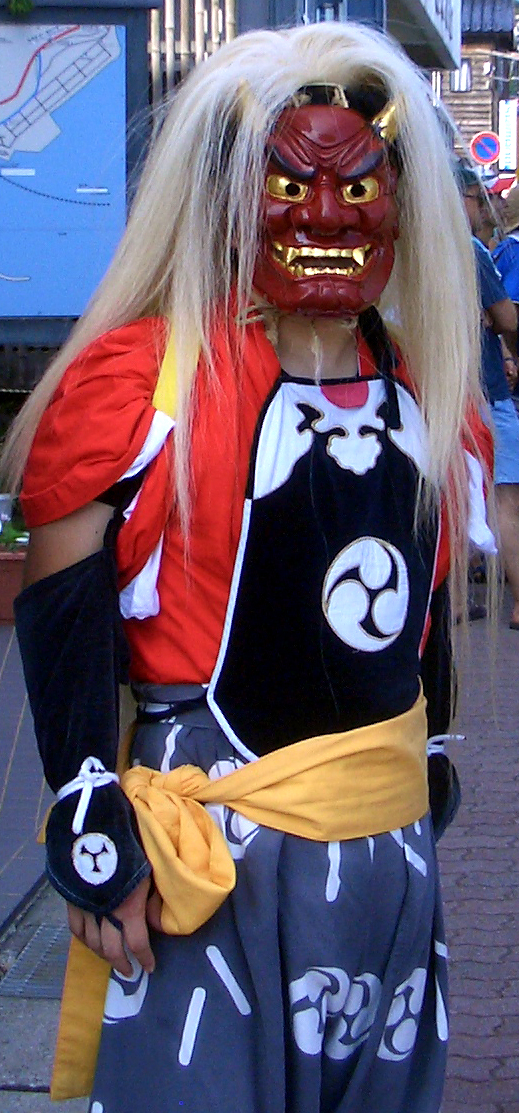
- Setsubun (節分): Real Japanese festival on February 3rd where families shout "鬼は外!福は内!" (Oni wa soto! Fuku wa uchi!, "Demons out! Good fortune in!") and throw soybeans to drive away 鬼. This is where the horned-mask-and-iron-club visual language comes from. It predates anime by about a thousand years.
If you have seen the horned red or blue masked figure anywhere in anime - the woodblock-print aesthetic, the iron club - that is a 鬼. The anime versions are borrowing an icon, not inventing one.
亀 - The Kanji on Goku's Back
亀 (kame) means turtle, and it is the character on Goku's orange gi.
Goku wears it because he trained under 亀仙人 (Kame-Sennin, Turtle Hermit) - Master Roshi. In Japan, students traditionally wear their master's symbol. So every time the camera pans across Goku's back across hundreds of Dragon Ball episodes, you are looking at a single kanji that means: this person learned from the Turtle Hermit.
Krillin wears the same one for the same reason. He trained under Roshi too.
The connection goes deeper: Kamehameha (かめはめは) starts with the kame syllable - the turtle character - every single time Goku calls it out. Akira Toriyama named the technique after the Hawaiian king Kamehameha I, but in Japanese the spelling begins with 亀 regardless. The most famous attack in anime history starts with a turtle.
Then there is the character development moment that most people miss. Later in Dragon Ball Z, Goku switches the kanji on his back from 亀 to 悟 (go) - the first character of his own name 孫悟空 (Son Goku). He stops wearing his master's symbol and starts wearing his own. It is a one-kanji way of saying: I am no longer just Roshi's student.
正義 - What the Marines Claim to Serve
正義 (seigi, justice) runs down the back of every Marine officer's coat in One Piece - white letters on black, impossible to miss, present in every scene where the Navy shows up.
The character breaks down cleanly: 正 (sei/tadashii, correct/righteous) + 義 (gi, duty/morality). Justice in Japanese is literally "correct duty" or "righteous morality."
And then Eiichiro Oda spends a thousand chapters asking whether the Marines mean it.
The Marines protect the World Nobles - a class of aristocrats who can enslave, murder, and extort civilians without consequence. They enforce a system that benefits the powerful and punishes the weak. When Akainu ordered the Ohara massacre and hunted down every ship of civilians fleeing a destroyed island, he called it 絶対的正義 (Zettaiteki Seigi, Absolute Justice). The same two characters. The same coat.
Aokiji's counter-philosophy is 怠惰な正義 (Taidana Seigi, Lazy Justice) - a deliberate slackening of the same word, the acknowledgment that absolute enforcement produces atrocity. Two marines, two readings of the same kanji on both their backs.
This is exactly what makes 正義 one of the richest kanji in anime. It is not just decoration on a uniform. The whole show is an argument about what those two characters mean and whether the people wearing them have any right to.
忍 - The Spine of Naruto
忍 (nin/shinobi) means endure, and it is the first character of 忍者 (ninjutsu, ninja). Look at the structure: 刃 (blade) positioned above 心 (heart). Endurance is literally bearing a blade above your heart - holding the edge at bay through will alone.
This is the word the entire Naruto franchise builds its philosophy on. Not power, not revenge, not the village - endurance. When Naruto refuses to give up on Sasuke for years against all logic, when Might Guy opens the Eighth Gate against Madara, when Naruto himself stands up after being beaten for the hundredth time - the Japanese concept underneath all of it is 忍. The hidden villages are organizations of people who trained this into their bones.
The word predates the franchise by centuries. Masashi Kishimoto did not invent it - he just put it front and center and built a story that earns it.
Vocabulary Callout
| Kanji | Romaji | Meaning | Famous For |
|---|---|---|---|
| 愛 | ai | love, affection | Gaara's forehead tattoo (Naruto) |
| 天 | ten | heaven, sky | Akuma's back kanji (Street Fighter) |
| 鬼 | oni | demon, ogre | Kimetsu no Yaiba title, Akuma's name |
| 亀 | kame | turtle | Goku's gi, Kamehameha (Dragon Ball) |
| 正義 | seigi | justice | Marine coats (One Piece) |
| 忍 | nin / shinobi | endure, ninja | Core philosophy of Naruto |
| 心 | kokoro / shin | heart, mind | Inside 愛 and inside 忍 |
心 (kokoro, heart) does not headline any franchise but lives inside both 愛 (love) and 忍 (endurance). The heart is the shared foundation. Every time you see either of those characters, you are also seeing 心.
Why This Matters for Your Japanese
The reason these kanji stuck - across tattoo shops, fan art, cosplay, and opening credits - is not because they look cool, though some of them do. It is because they are tied to specific emotional moments. Gaara's backstory hits, and suddenly 愛 is locked in. You watch the Marines coast up on a village waving 正義 and the contradiction lands. That is not how flashcards work. That is how emotional memory works.
Japanese vocabulary built on anime resonance sticks harder than vocabulary built on frequency lists. KitsuBeat songs are full of these characters - not as isolated items but in context, surrounded by the emotional weight they carry in the lyrics. Explore the song library on KitsuBeat and look for any Naruto, Dragon Ball, or One Piece track in the vocabulary callouts.
For more on how anime creators encode real Japanese mythology into character names, the Uchiha article covers how Kishimoto built a complete Shinto theological system into the Mangekyou jutsu names. Read: Why Are Uchiha Jutsus Named After Japanese Gods?
More deep dives into the language and mythology encoded in anime are in the Journal.
FAQ
What does the tattoo on Gaara's forehead mean?
The kanji on Gaara's forehead is 愛 (ai), which means love. Gaara carved it himself after his first assassination attempt, as a statement of self-love rather than love for others - because he realized no one else would love him. The character contains the radical for heart (心) at the bottom, making the word literally built around the heart.
What kanji is on Akuma's back in Street Fighter?
The kanji on Akuma's back is 天 (ten), meaning heaven or sky. He burns this character into the ground after using his Raging Demon super move. In context, 天 represents the transcendent summit he is striving toward - a human seeking to surpass human limits through the Satsui no Hado (Surge of Murderous Intent).
What does oni (鬼) mean in Japanese?
鬼 (oni) means demon, ogre, or supernatural being — 鬼滅の刃 (Kimetsu no Yaiba, Demon Slayer) puts this character in its title, Akuma's Japanese name is 豪鬼 (Gouki, great demon), and Setsubun tradition has used the 鬼 visual for over a thousand years. A 鬼 is not the Western devil — it can be fearsome while following its own code, which is why 鬼 characters in anime are often terrifying without being purely villainous.
What kanji is on Goku's gi in Dragon Ball?
The kanji on Goku's orange gi is 亀 (kame), meaning turtle. He wears his master's symbol - Master Roshi's title is 亀仙人 (Kame-Sennin, Turtle Hermit). The Kamehameha attack also starts with this character. Later in Dragon Ball Z, Goku replaces it with 悟 (go), the first character of his own name, marking the moment he steps out of his master's shadow.
What does 正義 mean in One Piece and why is it ironic?
正義 (seigi) means justice — 正 means correct, 義 means duty, so justice in Japanese is literally 'correct duty.' Every Marine officer's coat in One Piece carries 正義 down the back. The Marines' Absolute Justice (絶対的正義, Zettaiteki Seigi) is the clearest example: the word used to justify atrocity. Oda builds the entire political argument of One Piece around what those two characters actually mean.
What does the kanji 忍 mean and why is it central to Naruto?
忍 (nin) means endure or persevere, and it is the same character used in shinobi (忍者, ninja). The structure shows a blade (刃) positioned above a heart (心) - endurance is literally bearing something sharp above your heart. The entire Naruto franchise's theme of never giving up is encoded in this one character.
Why does Akuma's name translate to devil in English when his Japanese name is different?
Akuma's Japanese name is 豪鬼 (Gouki), meaning great demon or great ogre. The English localization chose Akuma (悪魔, devil) as a different name entirely. Both carry the concept of a demonic being, but 豪鬼 uses 鬼 (the horned oni) while 悪魔 uses the Christian-influenced devil concept. The original name Gouki better reflects his connection to Japanese oni mythology.